

What Are Extraordinary Circumstances
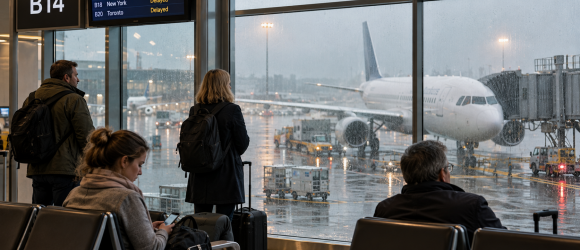
Simply put, extraordinary circumstances are events outside the airlines’ control that lead to flight disruptions like flight delays and cancellations and even denied boarding. This might seem like a handy way for carriers to avoid paying passengers flight delay compensation, but extraordinary circumstances are more than just an excuse for delays and cancellations. In fact they can usually be defined as an event that could not be avoided or prevented despite the airline’s best efforts.
If an airline says “extraordinary circumstances” caused your flight disruption, you may not be entitled to compensation—but don’t assume the airline gets the final word.
The US doesn’t have extraordinary circumstances rules equivalent to EU and UK, where the carrier must show that the delay or cancellation resulted from circumstances outside its control that couldn’t have been avoided even with reasonable measures. Still, American travelers need to be on their game when traveling abroad because they may encounter these protections, particularly on trips covered by EU or UK passenger rights. Canada, has its own rules for determining whether a disruption is within an airline’s control.
Key Takeaways
- Extraordinary circumstances can eliminate cash compensation, but airlines must prove the exemption applies.
- Mechanical problems and crew shortages don’t automatically qualify as extraordinary circumstances.
- US travelers can qualify for EU261 compensation on covered European flights, regardless of citizenship.
- Even when compensation isn’t owed, EU and UK passengers may still have rights to meals, hotels, rebooking, or refunds.
Taking a closer look at EU261 extraordinary circumstances rule for US travelers
EU261 flight compensation can apply to US travelers regardless of citizenship. What matters is your route and, in some cases, the airline operating the flight.
Flights departing the EU are generally covered, including flights to the US. Flights from the US to the EU can also qualify when operated by an EU airline. So, if an airline denies compensation because of “extraordinary circumstances,” where you flew and who operated the flight can make all the difference.
For a flight departing from an EU airport, the operating airline’s nationality generally doesn't matter. For example, Paris → New York can be covered whether it's operated by Air France, Delta, or another carrier.
For a flight from the US into the EU, however, EU261 generally applies only when the operating carrier is an EU carrier. So New York → Paris on Air France can be covered, while New York → Paris on Delta generally is not. The European Commission describes this distinction in its passenger-rights guidance.
Also, “operating carrier” matters more than the airline that sold the ticket because of codeshares. You might buy a ticket carrying an Air France flight number, for example, but if another airline actually operates the aircraft, that can affect EU261 coverage.
AirAdvisor can help you along the whole process. From arguing with the airline regarding flight delay due to technical problems to defending your right to compensation in court. The great news is that our services are free of charge so there is no risk for you.

Examples of extraordinary circumstances
For Americans traveling on flights covered by EU passenger protection rules, what counts as an extraordinary circumstance isn’t always cut and dried. Severe weather, air traffic control restrictions, security threats, political instability, bird strikes, and many events caused by third parties can qualify.
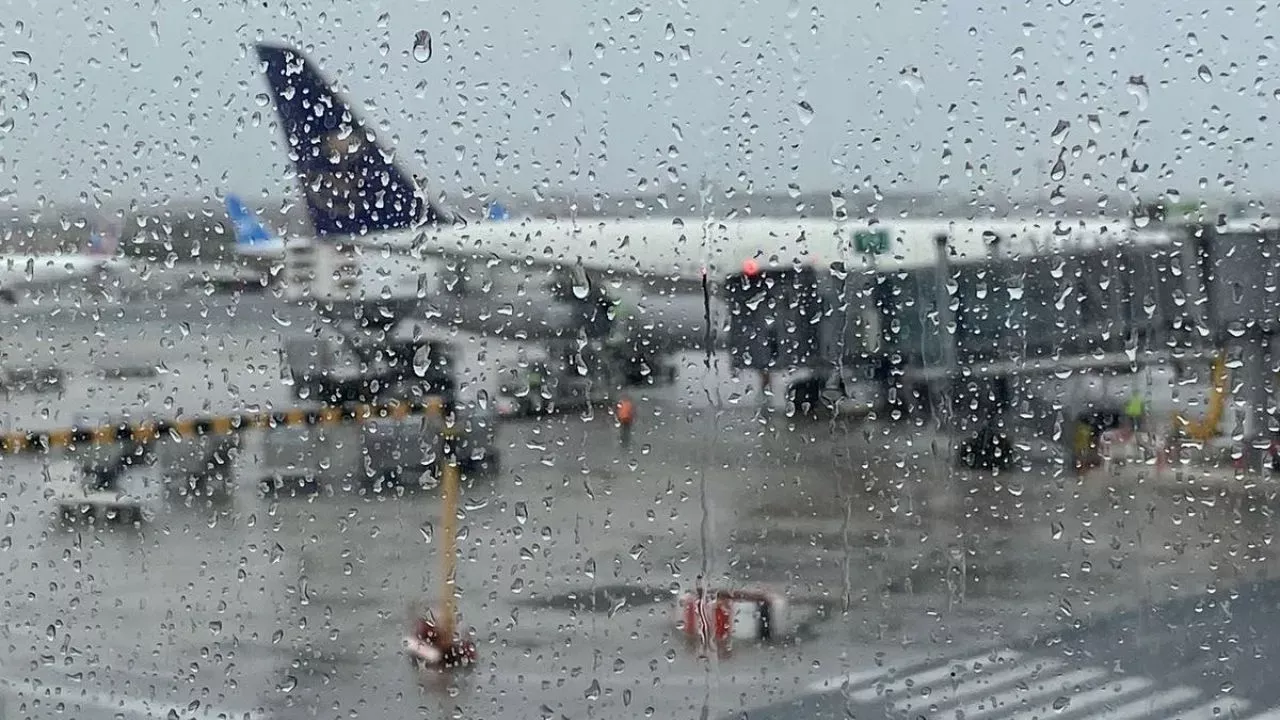
- Dangerous weather including severe thunderstorms, hurricanes, blizzards, dense fog, or other sudden conditions that can create safety concerns and lead to delays and cancellations.
- Bird strikes where a bird (or sometimes other wildlife) collides with the airplane and causes damage. This leads to follow-up maintenance that was unscheduled and can result in disrupted flights.
- Issues with air traffic control such as employee strikes or restrictions caused by airspace congestion.
- Airport strikes
- Airport problems such as damaged runways or technical failures that are beyond the airline’s control
- Medical emergencies where the aircraft must be diverted or forced to land to address the issue.
- Natural Disasters including volcanic eruptions, earthquakes, floods, and tsunamis
- Security threats/risks that lead to airport lockdowns or flight restrictions. This can also include unruly passengers whose behaviornecessitates a diversion or emergency landing.
- Political unrest like wars, severe political instability, travel bans, and civil unrest.
- Unforeseen natural phenomena, also called Acts of God, like volcanic ash clouds or other sudden and unforeseen natural events that lead to flight disruptions.
- Manufacturers defects with the aircraft that are outside the scope of routine maintenance.
But airlines don’t get a free pass for every problem beyond their control. Routine and even unexpected mechanical or technical problems generally aren’t extraordinary circumstances (Wallentin-Hermann, C-549/07; van der Lans, C-257/14), while a bird strike generally is (Pešková, C-315/15). Even strikes require a closer look: an airline’s own staff “wildcat strike,” for example, was held not to qualify (Krüsemann, C-195/17).
Figuring out how much you are owed for a disrupted flight can be complicatedWe're here to helpLet us assess your compensation for you.Check Your Flight
Common misconceptions
There are some situations that can seem confusing when trying to figure out if extraordinary circumstances apply.
Crew shortages. Not an extraordinary circumstance. Airlines are expected to have enough pilots and flight attendants to operate their schedules. In the US, the Department of Transportation specifically lists “crew problems” among the causes of flight disruptions considered within an airline’s control. So if your flight gets scrubbed because the airline is short a pilot or flight attendant, don’t assume the airline automatically gets a pass.
- Technical issues. One common misconception is that anything unexpected in the mechanical realm automatically counts as an extraordinary circumstance. It doesn’t. European courts have ruled that these kinds of routine technical problems are part of running an airline—not extraordinary circumstances (van der Lans, C-257/14). Aircraft are complicated machines, and parts wear out, break and need maintenance. But note: A genuine hidden manufacturing defect is another story.
- Overbooked flights. US airlines sometimes sell more tickets than there are seats because they expect some passengers to be no-shows – not a popular game plan with travelers. In fact, according to a 2017 press release from the New Jersey Office of the Governor, former New Jersey Gov. Chris Christie called the practice “Outrageous.” Yet, The US Department of Transportation makes clear that overbooking is a legal business plan and not the stuff of extraordinary circumstance.
One exception to this could be if a safety issue arose in the originally scheduled aircraft that caused the carrier to switch to a smaller plane. If this happens then the denied boarding incident is attributed to the safety concern and not to overbooking.

In order to reduce payouts to disgruntled travelers, airlines tend to over-use the ‘extraordinary circumstances’ exception even though Art. 5(3) clearly places the burden of proof squarely on the carrier.
- Anton Radchenko, Esq. (Founder & CEO, AirAdvisor).
How it affects airline compensation
Yes, there is such a thing as a free lunch. In the EU and UK, extraordinary circumstances can get an airline off the hook for paying cash compensation—but they don’t wipe out all your passenger rights. The airline may still owe you meals and refreshments, hotel accommodations for an overnight delay, and transportation to the hotel. Depending on the disruption, you may also have the right to a refund or another flight.
United States
The US has no federal cash-compensation requirement for ordinary flight delays or cancellations. The best you can expect is a refund that returns you money – nothing as sweet as extra compensation for the inconvenience. That’s because DOT rules require airlines to provide an automatic refund when they cancel or significantly change a flight and the passenger chooses not to accept alternative transportation or travel credits. The refund must go back to the original form of payment and generally must be issued within seven business days for credit card purchases or 20 calendar days for other payment methods.
United Kingdom and the European Union
Under EU261, eligible passengers can receive €250 (approx. $290) for flights of 932 miles or less, €400 (approx. $465) for flights of 932–2,175 miles or intra-EU flights over 932 miles, and €600 (approx. $697) for flights over 2,175 miles. Extraordinary circumstances can relieve the airline of this compensation requirement.
Canada
Canada goes the extra mile. As with the UK and EU, Canada requires airlines to compensate passengers for delays and cancellations unless extraordinary circumstances are to blame for the disruption. Large airlines pay CAD $400 (approx. $288) for 3 to 6 hours late arrival; CAD $700 (approx. $500) for 6 to 9 hours; CAD $1,000 (approx. $720) for 9 hours or more. Small airlines pay CAD $125 (approx. $90); CAD $250 (approx. $180); CAD $500 (approx. $360).
Additionally, the Air Passenger Protection Regulations (APPR) that is governed by the Canadian Transportation Agency (CTA) outlines passenger rights and requires carriers to give passengers care, assistance, refunds, and alternate bookings when flight disruptions occur, even if they are the result of extraordinary circumstances.

The APPR sorts disruptions into three categories: within the airline's control, within its control but required for safety, and outside its control. Compensation is owed for the first category only.

What you can do
If your flight is delayed or canceled while traveling abroad, don’t take “extraordinary circumstances” at face value. Under EU rules, the airline has to prove that the circumstances qualify and that the disruption couldn’t have been avoided with reasonable measures.
Before leaving the airport, ask the airline for the specific reason for the disruption. Additionally:
- Save your boarding pass and booking confirmation
- Save your emails, texts, app notifications, and receipts for meals, hotels, and transportation.
- Take screenshots of the flight status and check whether other airlines are experiencing similar problems.
Most importantly, don’t assume that bad weather, a mechanical problem, or a vague “operational issue” automatically kills your claim. The details matter.
AirAdvisor won case study: when a mechanical problem isn’t an extraordinary circumstance
If there are widespread delays and cancellations, chances are it was caused by an extraordinary circumstance.
Disrupted flight?You might have a right to compensation - up to €600.Check Your Flight





 5 minutes read