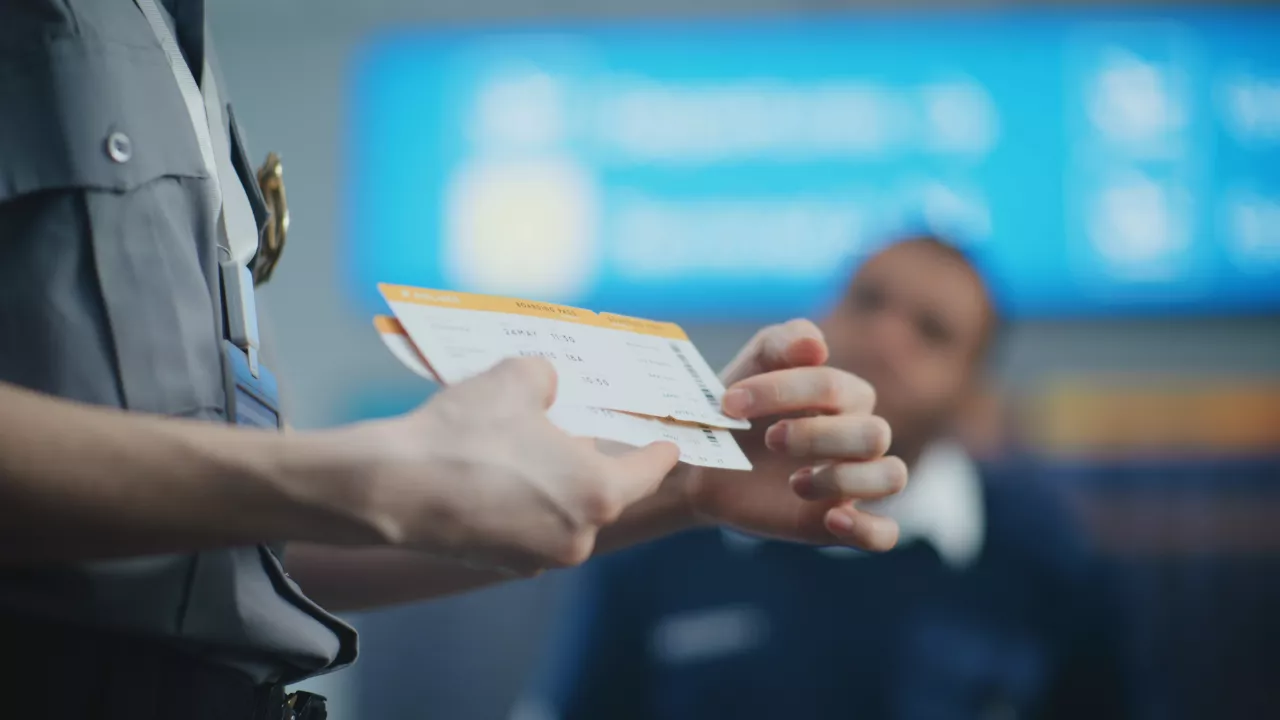



The US government can flag you for additional security screening before you even reach the airport, without telling you why, and with no obligation to ever explain. If you see SSSS printed on your boarding pass, you have been selected. But don’t take it to heart because it can happen to anyone, on any flight connected to the United States, including one that just crosses American airspace without landing.
Key takeaways
- SSSS stands for Secondary Security Screening Selection
- It is issued by the TSA's Secure Flight programme
- It applies to any passenger on a US-bound, US-departing, or any flight flying over the continental United States
- If you see this on your boarding pass, you will undergo extra security screening that typically involves a pat-down, bag inspection, body scan, and explosive trace testing
- Getting SSSS on your boarding pass can add an extra 15–45 minutes to your security process.
- If you keep receiving SSSS repeatedly, you can apply for a free DHS TRIP Redress Number
What does SSSS mean on a boarding pass?

Photo by Definitelynotdodgy / Wikimedia Commons / CC BY-SA 3.0
SSSS stands for Secondary Security Screening Selection. It means you’ve been chosen for enhanced security checks before you board.
The system behind it is called Secure Flight, a passenger pre-screening programme run by the US Transportation Security Administration (TSA). It was put in place after the September 11 attacks, as part of the most significant overhaul of US aviation security in the country's history.
How passengers are chosen for enhanced screening
Secure Flight runs passenger names against intelligence databases and government watchlists before flights depart. If your profile triggers a flag, SSSS appears on your boarding pass and security staff are alerted to pull you aside.
SSSS and the No-Fly list
Most people who see SSSS on their boarding pass confuse it with being on the No-Fly list, but these are two completely different things.
If you are on the No-Fly List, you cannot board your flight at all. In fact you won’t be able to get a boarding pass. So always remember this:SSSS simply means enhanced screening before boarding. It’s not a ban from air travel. Also, a boarding pass with SSSS on it is still a usable boarding pass.

A better way to travel is coming soon.
Get paid automatically when your flight or luggage is disrupted — protection up to €10,800 per trip.
Please wait ...
Your information is secure
Your spot is reserved 🎉
We’ll notify you as soon as our new travel protection is live.

Know someone who should be here with you?
Every traveller you invite gets ahead of the public launch.
Your personal invite link — share it with friends and they'll get early access too.
We'll also send this link to your email.
Get early access
We’ll notify you as soon as our new travel protection is live.
You’re already on the list 🎉
We’ll notify you as soon as AirAdvisor+ launches.
Who can be flagged for enhanced screening?
Anyone who departs from, arrives at, or travels within the United States, including flights that pass over the continental US airspace at cruising altitude, could find SSSS on their boarding pass. It doesn’t matter your citizenship status, your place of origin, airline, or airport. If your travel involves the US, you could, unfortunately, be flagged, even if the US isn’t your final destination.
Also, some travel patterns can increase your chances of getting the SSSS designation, like:
- booking a one-way international ticket at short notice,
- travelling to or from a country the US considers higher risk, or
- sharing a name with someone already on a watchlist can all draw attention.
Random selection plays a role too, as the TSA makes the system unpredictable on purpose so no travel profile is entirely immune.
Where is SSSS on your boarding pass?
Grab your paper boarding pass and look for SSSS printed in bold in the upper left or lower-right corners. Sometimes you might see it displayed as a single “S”, and if you’re flying Southwest Airlines look for a checkerboard pattern.

You won’t see any of these markings on a digital boarding pass because if you’re flagged, you won’t be able to generate one at all. You’ll go to check in online and rather than completing the process, you’ll get an error message or the airline app will tell you to see a desk agent. If this happens, there’s a really good chance you’ve been chosen, but you'll know for sure once the agent prints your paper boarding pass.
Also, some airlines will message you directly if you’re flagged. If you get a text, email, or app notification with no explanation, it can be a sign that you’ve been selected. But bear in mind that getting a message like this from your airline could mean you have something else going on, like a name mismatch, an incomplete booking, or a passport issue.
Is anyone exempt from enhanced TSA screening?
Honestly, no one is exempt from the potential SSSS. Anyone travelling to, from, or over the continental US could be flagged, including:
- First class passengers
- Business class passengers
- Elected officials
- Cabin crew members
- TSA PreCheck, Global Entry, CLEAR, and NEXUS passengers
Minors are the only group that the TSA says are officially off the list. But in practice, children can be pulled aside for extra screening, especially if their name is similar to someone on the Selectee list.
Getting SSSS at the gate
Every once in a while, SSSS can be added at the gate, even if your original boarding pass showed nothing. This is because the Secure Flight System continues working after check-in right up to the time you board.
Passenger account (Reddit, u/SamCam9992): "They will never tell you why you are flagged. It could be that you have a weird travel history, the same name as someone on a no-fly list, or any other reason really. I get flagged a lot because I fly standby as a staff member and often fly weird routes or book extremely last minute. Since your SSSS was only added after you flew your first leg, it's likely they only added it after you checked in. Very annoying, but I saw it happen a few times when I was working as a gate agent."
If you suspect you might have SSSS, tell the check-in agent before they hand you the pass. They can walk you through what to expect and, at some airports, alert the security team so your screening slot is ready.

What actually happens if you’re flagged with SSSS
If you do have SSSS on your boarding pass, the good news is that you can usually bypass the regular security queue. But still, the process can feel intimidating, so here's what to expect.
First, when your boarding pass is scanned, you’ll hear a loud beep and a flashing red light. Then a TSA agent will radio for a supervisor. You may hear them say "we've got a quad," or something along those lines, which is TSA shorthand for the four Ss.
A supervisor will then walk you to a secondary screening area where you will go through the following steps:
- Body scanning. You will go through both a metal detector and an advanced imaging scanner. Both are standard for every SSSS passenger.
- A thorough manual check of your body. This will be carried out by an officer of the same sex wherever possible. You can ask for this specifically if it is not offered. You also have the right to request a private area and have a companion or witness present.
- Your carry-on will be opened and examined, item by item. On some international routes, your checked bags may be pulled separately as well.
- Every device will need to be switched on to prove it works, so make sure everything is charged before you leave for the airport.
- Your hands, shoes, and bags will be wiped with a test strip and checked for explosive residue, but this will only take a few seconds.You’ll be asked where you are going, why, for how long, who with.
- You’ll be asked where you are going, why, for how long, who with. This is all standard procedure, so answer calmly and honestly. Then the supervisor will photograph your boarding pass and ID and complete a short form.
How long does it take?
Most passengers say that it takes between 15 and 45 minutes, but sometimes it can be much faster. It all depends on the departure airport, how much you are carrying, and how quickly a supervisor shows up to complete the screening.
Passenger account (Reddit, u/jasikanicolepi): "I got selected for SSSS. It's a quick pat down and they swabbed my shoes, electronics and hands when I came back from Cabo for vacation for a connection. It was pretty quick since I didn't have a whole lot of stuff. Just a carry-on bag and a bottle of alcohol from a duty free store. The whole process took like 5 mins or less and I didn't miss my flight. Had probably 20 mins to spare before my flight took off."
Once the process begins, you cannot leave the screening area and rejoin the general security queue. When the screening is over, you will be escorted directly to your boarding gate.
SSSS for disabled passengers
If you have a disability or medical condition, you can request adjustments to the screening process, including a private area, a seated pat-down, or special handling of medical devices. Call TSA Cares on 1-855-787-2227 at least 72 hours before you fly to arrange this in advance.
Always get a boarding pass stamp
When your screening is complete, the TSA agent will stamp your boarding pass. That stamp is your proof that screening is done. When your boarding pass is scanned at the gate, it will sound another alarm because the SSSS flag is still on your boarding pass.
At this point, the gate agent will look for the TSA stamp to confirm you’ve already been cleared. If you don’t have a stamp, the gate agents will have to call a TSA agent back to the gate, which means your flight could be delayed as a result.
How to reduce your chances of getting flagged
You might not be able to avoid getting flagged completely, but here’s how to minimise the chances of it happening:
- Book return tickets where possible, particularly on transatlantic routes. One-way bookings are a consistent trigger.
- Book early, because last-minute bookings can dramatically increase SSSS risk on international flights.
- Use your full legal name consistently and be sure the name on your passport is exactly the same across every booking.
- Use the same email address, payment method, and loyalty number across bookings as well.
- Apply for a Redress Number if SSSS keeps happening.
DHS TRIP: What to do if you keep getting SSSS
Step 1: Document every occurrence. Keep a record of each flight where you got an SSSS and include the date, route, airline, and any unusual circumstances around the booking. This documentation will be useful when you file a TRIP inquiry. (Department of Homeland Security Traveler Redress Inquiry Program.)
Step 2: Apply for a DHS TRIP Redress Number. Visit the official DHS TRIP portal at dhs.gov/dhs-trip. The application is free and takes around 15–20 minutes to complete online. You will need to provide personal details, travel documents, and a description of the recurring SSSS problem. When you complete the form, you will receive a seven-digit Redress Control Number once your case is assigned.
Step 3: Add your Redress Number to every booking. Most airline booking systems have a dedicated field for this. Save it to your frequent flyer profile so it is applied automatically.
Step 4: Wait and monitor. DHS TRIP cases can take several weeks to process. Some passengers see SSSS disappear within a month, but others find a second application is needed if the problem keeps happening.
Step 5: If the problem persists after two applications, consider contacting a civil liberties organisation or seeking legal advice if you believe the flagging is connected to your name, nationality, or background rather than any genuine security concern
Claim with AirAdvisor and get up to €600 compensationFind out how much you’re owed today.Check Your Flight
Frequently Asked Questions
Not automatically. SSSS is assigned at an individual level. Two people on the same reservation can, and frequently do, receive different designations.
Technically, yes, but if you refuse, you will be denied boarding. Secondary screening is a condition of travel on US-bound and US-originating flights.
Not necessarily. At some airports, SSSS passengers are screened early and board first. At others, the screening happens at the gate as boarding closes. It varies entirely by airport, airline, and the individual staff involved.
Sometimes, yes. If you believe there has been an error, like a name mismatch, contact your airline or the TSA before travel and provide additional documentation (passport, booking history).