Summer flight cancellations 2026: what the data actually shows
EU flight cancellations are up 378%, but 47% trace to five German airports. See which routes are affected, which are not, and what your rights are if your flight is cancelled.


For the past two weeks, travel news has read like a slow-motion disaster unfolding. Reports of fuel shortages are grounding flights across Europe, mass cancellations are mounting, and if you have spent any time recently staring at your booking confirmation and wondering whether your summer plans are about to unravel, you are far from alone.
Before you do anything drastic, here is what the data actually shows.
AirAdvisor tracked more than two million EU flights between 8 April and 8 May 2026 and set them against the same 30-day window in 2025.
The data shows that EU cancellations are up 378% year on year, but the reality behind that figure is far more concentrated than recent coverage suggests. Nearly half of all cancelled EU flights in this period trace back to five German airports.
If your summer flight does not connect through those hubs, the story looks considerably different.
What things looked like this time last year
During the same period in 2025, Europe's worst-performing airports were concentrated along Middle East flight corridors.
- Tel Aviv Ben Gurion Airport (TLV) was running a 3.11% cancellation rate.
- Brussels Airport (BRU),Athens International Airport (ATH) and Helsinki-Vantaa Airport (HEL) were all struggling, their cancellation rates inflated by the widespread suspension of Israel routes following the conflict in the region.
- Frankfurt Airport (FRA), now the most cancelled airport in the EU, was cancelling just 0.23% of its departures at this same point last year.
A year on, every one of these airports have improved significantly or dropped off the “worst” list entirely.
The Germany problem, by the numbers
- Frankfurt Airport's (FRA) cancellation rate went from 0.23% last spring (roughly 1 in every 435 departures) to 9.06% today (1 in every 11 flights).
- Munich Airport (MUC), which did not appear on last year's worst airport list at all, is now cancelling 13.18% of its departures, roughly 1 in 8 flights.
- Hamburg Airport (HAM) is at 6.46% (1 in 15).
- Berlin Brandenburg Airport (BER) at 4.39% (1 in 23).
- Düsseldorf Airport (DUS) at 2.77% (1 in 36).
Together, those five airports account for 47% of every cancelled EU flight in the past 30 days, with Frankfurt alone responsible for more than 1 in 4 cancelled flights. The fuel shortage has hit Germany harder than anywhere else in Europe, and the data shows exactly why: the carrier at the centre of it is Lufthansa.
The Lufthansa factor
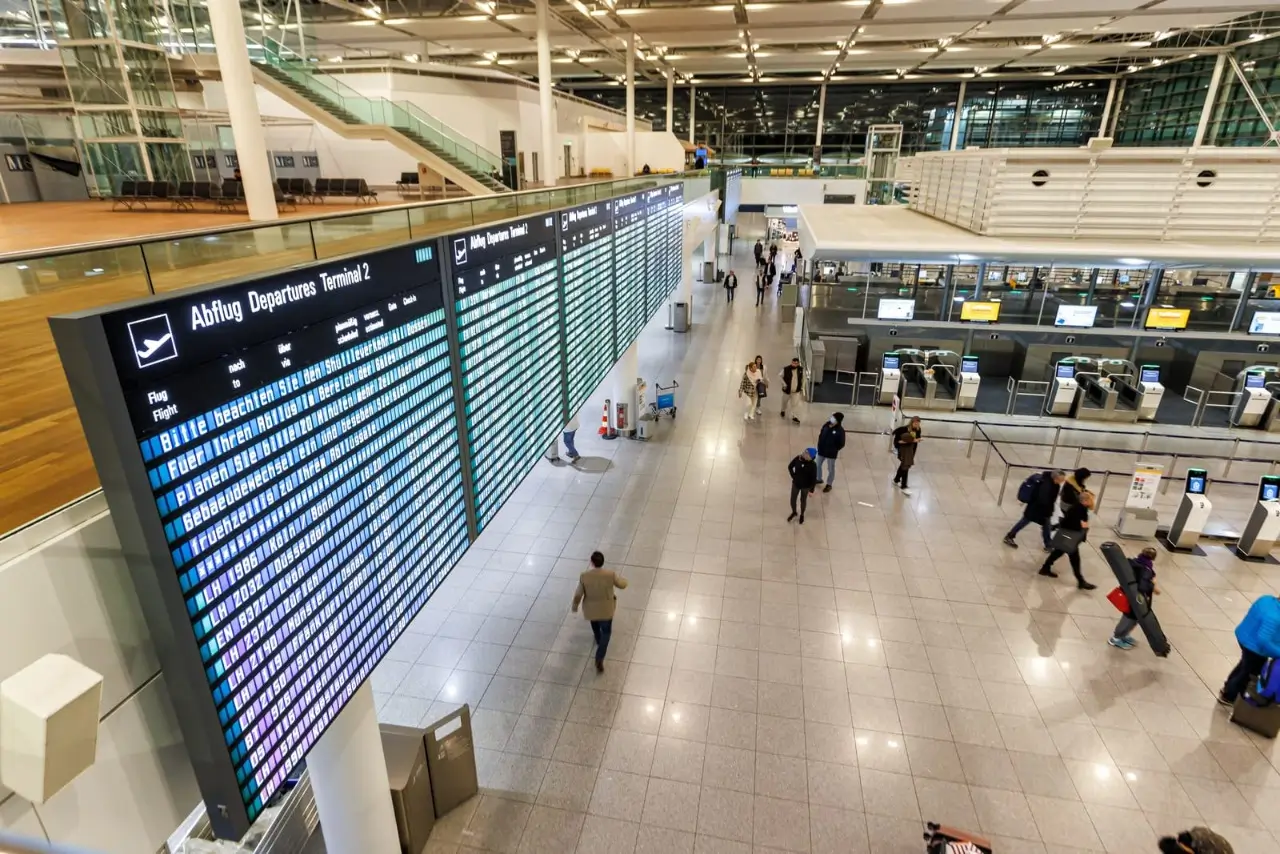 Looking at Lufthansa alone tells its own story.
- At Frankfurt, the airline's cancellation rate went from 0.27% last year (roughly 1 in every 370 departures) to 13.68% today (1 in every 7 flights).
- At Munich it is now 18.11%, with 1 in every 5 Lufthansa departures cancelled.
- At Hamburg, the cancellation rate stands at 23.19%. At Berlin-Brandenburg, it is 28.56%, closer to 1 in every 3 flights.
Lufthansa accounts for approximately 34% of all Frankfurt's cancellations over this period, making it by far the single largest contributor at the airport that is itself responsible for more than a quarter of every EU cancellation. If your summer flight is operated by Lufthansa, or connects through one of its German hubs, the disruption is real and the data reflects it.
Lufthansa cancellation rates by airport: 2025 vs 2026
Airport | Lufthansa 2025 rate | Lufthansa 2026 rate | Change |
Frankfurt Airport (FRA) | 0.27% | 13.68% | +4,970% |
Munich Airport (MUC) | 0.28% | 18.11% | +6,368% |
Hamburg Airport (HAM) | <0.1% | 23.19% | New |
Berlin Brandenburg Airport (BER) | 1.18% | 28.56% | +2,320% |
Düsseldorf Airport (DUS) | 0.20% | 21.26% | +10,530% |
Bremen Airport (BRE) | <0.1% | 35.71% | New |
London Heathrow Airport (LHR) | 0.85% | 8.06% | +848% |
Barcelona El Prat Airport (BCN) | Not in top 10 | 19.78% | New |
Amsterdam Schiphol Airport (AMS) | 1.40% | 17.36% | +1,140% |
Why most of Europe is not in the same situation
For most passengers flying from the UK this summer, the picture is considerably calmer.
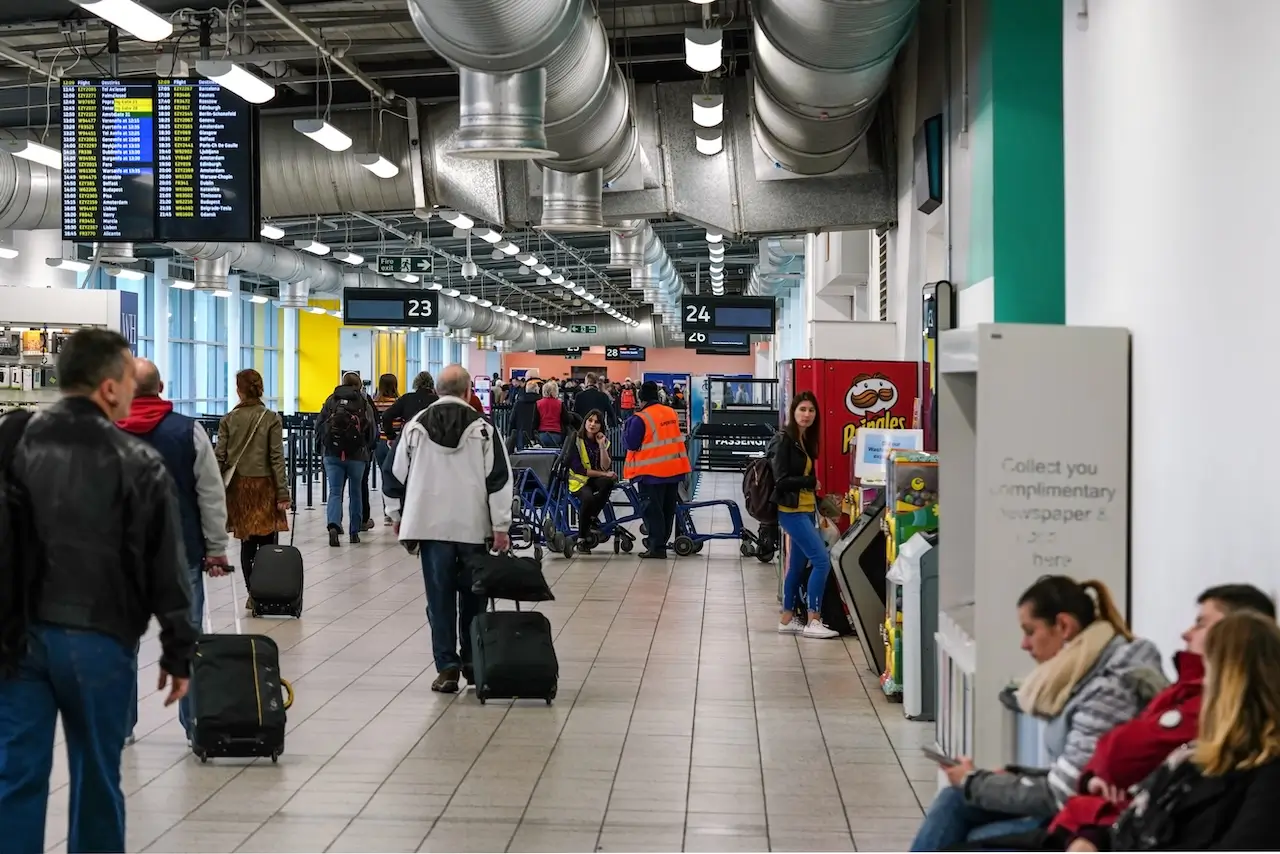
- France's cancellation rate has fallen from 0.32% this time last year to 0.13% today, fewer than 1 in every 750 departures, the lowest of any major EU country.
- The UK's overall rate improved year on year, from 0.39% to 0.31%, roughly 1 in every 320 flights.
- Finland's cancellation rate has dropped from 2.18% last spring to 0.99% today.
- Greece and Belgium, both in the 10 worst EU countries last year, have dropped off the list entirely.
- Paris Charles de Gaulle Airport (CDG), which appeared in last year's worst airport rankings, does not feature this year at all for this time period.

The EU-wide cancellation rate of 1.66%, the number driving most of the headlines, is heavily skewed by what is happening at German airports.
Strip those five airports out of the mix, the cancellation rate for the rest of Europe drops to approximately 0.97%. That is still higher than last year's 0.35%. But it does, however, put the scale of recent cancellations in a different light.
Cancellation rates by country: (April 8 - May 8, 2025 vs April 8 - May 8, 2026)
Country | 2025 rate | 2026 rate | Change |
France | 0.32% | 0.13% | -59% |
Finland | 2.18% | 0.99% | -55% |
Portugal | 0.48% | 0.34% | -29% |
UK | 0.39% | 0.31% | -21% |
Netherlands | 0.33% | 0.33% | Flat |
Sweden | Not in top 10 | 0.46% | New entry |
Norway | Not in top 10 | 0.46% | New entry |
Spain | 0.28% | 0.33% | +18% |
Italy | 0.12% | 0.19% | +58% |
Germany | 0.23% | 0.25% | +9%* |
Greece | 1.08% | Not in top 10 | Improved |
Belgium | 1.37% | Not in top 10 | Improved |
If you are booked on a direct flight from the UK to Spain, France, Greece, Italy or Portugal, you are not flying into the same situation that is generating the cancellation numbers you’ve been reading about.
Outside Germany, most of the continent is in better shape than last year. A handful of airports are the exception, and they are worth knowing about if your route passes through them.
The airports outside Germany worth watching
- Amsterdam Schiphol Airport (AMS) has seen its cancellation rate rise from 0.33% last year to 1.01%, roughly 1 in every 99 departures.
- Barcelona El Prat Airport (BCN) has moved from 0.56% to 1.01%.
- London Heathrow Airport (LHR) from 0.51% to 0.79%, 1 in every 127 flights.
- Copenhagen Airport (CPH) is a new entry in the worst-performing list at 1.82%, 1 in every 55 departures.
These figures are higher than last year and worth being aware of, particularly if you are connecting through those airports rather than flying direct. But still, none of them come close to what is happening in Germany. To put it in context, Frankfurt's cancellation rate right now is eleven times higher than Heathrow's.
Worst airports: how the picture changed from Spring 2025 to 2026
Airport | 2025 rate | 2026 rate | Change |
Frankfurt Airport (FRA) | 0.23% | 9.06% | +3,839% |
Munich Airport (MUC) | 0.28% | 13.18% | New crisis |
Hamburg Airport (HAM) | 0.21% | 6.46% | New crisis |
Berlin Brandenburg Airport (BER) | 0.57% | 4.39% | New crisis |
Düsseldorf Airport (DUS) | 0.20% | 2.77% | New crisis |
Copenhagen Airport (CPH) | Not in top 10 | 1.82% | New entry |
Amsterdam Schiphol Airport (AMS) | 0.33% | 1.01% | +206% |
Barcelona El Prat Airport (BCN) | 0.56% | 1.01% | +80% |
Rome Fiumicino Airport (FCO) | Not in top 10 | 0.90% | New entry |
London Heathrow Airport (LHR) | 0.51% | 0.79% | +55% |
Tel Aviv Ben Gurion Airport (TLV) | 3.11% | Not in top 10 | Improved |
Brussels Airport (BRU) | 2.01% | Not in top 10 | Improved |
Athens International Airport (ATH) | 1.47% | Not in top 10 | Improved |
Helsinki-Vantaa Airport (HEL) | 1.39% | Not in top 10 | Improved |
Paris Charles de Gaulle Airport (CDG) | 0.24% | Not in top 10 | Improved |
One thing every passenger should check before they fly
Travel insurers are beginning to deny claims for cancellations caused by the fuel shortage, on the basis that it is now a widely known and foreseeable event. If you purchased your travel insurance recently, check your policy's exclusions section carefully. The assumption that a cancelled flight is automatically covered may no longer hold.

Tired of chasing airlines?
Get paid within hours.
Automatic protection up to €10,800 — payouts within hours if your trip is disrupted.
What that does not affect, however, is your statutory passenger rights.
Travel insurance and passenger rights law are entirely separate systems, and one has no bearing on the other.
If your flight is cancelled, here is what you are entitled to
An airline that cancels your flight is legally required to offer you a full cash refund or an alternative route to your destination. That obligation sits with the carrier regardless of the reason for the cancellation, and it does not change because of the fuel shortage.
Beyond the refund, if your flight was cancelled with less than 14 days' notice and no acceptable alternative was offered, you may also be entitled to compensation. Under UK261 for UK-departing flights, that is up to £520 (€600) depending on route distance. EU261 applies the same thresholds for flights departing from EU airports.
Airlines will argue that the fuel shortage constitutes extraordinary circumstances, a legal defence that, if accepted, removes the compensation obligation while leaving the refund right intact. It is not a guaranteed argument.

The extraordinary circumstances defence is not automatic, and airlines do not always succeed with it, says Anton Radchenko, aviation lawyer and co-founder of AirAdvisor. If your flight was cancelled with less than 14 days' notice and no acceptable alternative was offered, a claim is worth pursuing.

If your flight is cancelled, do not accept a travel credit or voucher
Doing so could affect your right to a cash refund and may eliminate your ability to claim compensation separately.
What this all means for your summer plans
The headlines are alarming, and the data behind them is real. But when you compare what’s happening right now to the same 30 days last year, the picture is not the continent-wide catastrophe the coverage implies.
EU cancellations are up sharply, yes, but the vast majority of that increase traces back to five German airports and one airline facing a supply crisis at its hubs.
The countries and airports that most UK passengers are flying to this summer, Spain, France, Greece, Italy and Portugal, are operating at rates that are broadly comparable to, and in several cases better than, where they were twelve months ago.
This is where things stand this week. The fuel shortage is ongoing and the situation could change at any time, so always be sure to stay up to date with what’s happening with your specific itinerary.
Preparing for sudden flight disruptions
Check your route, not just the headlines.
- If you are flying direct to southern Europe, your cancellation risk is low.
- If you are connecting through Frankfurt or Munich on Lufthansa, build in flexibility and know your rights before you travel.
Check your travel insurance policy, specifically what it covers for flight cancellations caused by the fuel shortage, and whether you purchased it before or after the crisis became widely reported.
If your flight is cancelled, request a cash refund and check your compensation eligibilityIf you flew in the past 30 days and your Lufthansa flight was cancelled, it is worth checking whether you have a claim.Check my flight
Data: AirAdvisor's AirData real-time flight tracker, powered by OAG (200 million+ flight records) and Spire Aviation. Period: 8 April to 8 May 2026, compared with the same dates in 2025. EU-regulated flights only. Data updated weekly.

Author:
Joanna TeljeurJob/Position: Senior Editor & Content Lead
Joanna Teljeur is a senior editor and writer with 15+ years of experience in editorial leadership, journalism, and content development, specialising in consumer rights, aviation law, and public-interest reporting. Her work focuses on transforming complex regulatory and legal topics into clear, accurate, and accessible content for international audiences.